

Links
Sendd.store (live product + landing page): https://www.sendd.store/
Sendd.market (V1 live): https://www.sendd.market/
Wellington (our first live marketplace): https://wellington.sendd.market/
📅 Book 15 minutes with me: https://sendd.store/sendd
Traction (June 2026)
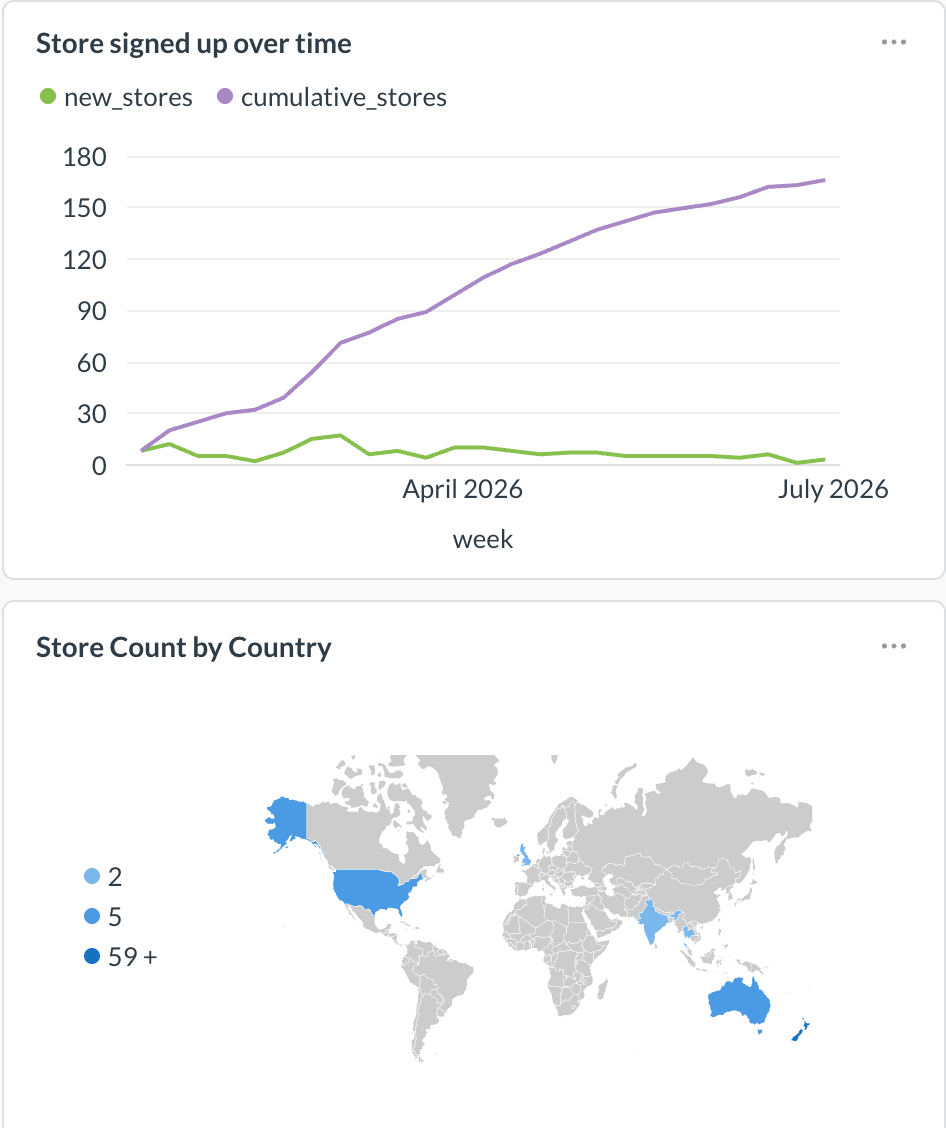
166 stores live on Sendd.store: up from ~147 in May (+13% MoM), ~19 new this month.
Payment volume $160.54 USD: down 95% MoM (from $3,311.65).
8 successful payments: down 94% MoM (from 126), at a ~$20 USD average order.
Sendd revenue $5.85: the ~1% net take, down 90% MoM (from $56.84).
~13% month-on-month referral-driven customer growth, measured and sustained since launch in late January, with almost no sales or outbound in the last two months.
~100.7K organic views across channels at $0 spend: Instagram 70,569 (five accounts, led by Just Sendd It at 46,969), TikTok 27.1K (Just Sendd It) and LinkedIn 3,049. Up ~17% on May’s ~86K, with TikTok newly in the count this month. Every individual channel softened on its prior 31 days while I was offline.
4.22k web visits / 5.68k page views (new metric this month, via Cloudflare): the US is our #1 traffic source.
June burn 12k NZD: down from 20k+ in May.
Summary
When it rains, it pours. June was one of those seasons for me and for Sendd. It’s the part of the movie where the protagonist is trudging along under some cover in the pouring rain and a car drives past and soaks them anyway. Almost everything took a hit this month, and part of my promise in these updates is not to sugarcoat things, so let me tell it straight.
Startups, like any high-performance team sport, is a momentum game. We had real momentum heading into the US and through our first month and a bit there: content, customers, revenue, all climbing. Me being off the field for most of two months broke it. Engineering slowed. Content fell off a cliff outside of one account. Local sales and distribution essentially stopped. And the numbers followed: GMV grew hard through March and April, then reversed over the two months I was out, down 46% in May and around 95% in June. As a founder building in public you’re always on the clock, and I’m very competitive, losing ground against our own targets is painful. While the US trip was invaluable and we 3x our marketplace waitlist numbers & got commitment from a multimillion dollar US brand to launch on Sendd. It created problems in our home turf.
I also made two hard calls on the team this month, ending two contracts. I won’t name people, because this isn’t about them personally and I want them to go on and do well. But the reasoning matters, because it sets the standard for everyone who joins from here. One was someone we’d invested a lot in who stepped back when Sendd needed them most. When the level of challenge we’re playing at can’t be met without stepping away at the hardest moment, I don’t see the path to them one day running operations at Sendd independently at the highest level, especially when it gets hard and that’s the bar. The other was a straight ROI call: the content they made drove views and built brand, but under 20% of the businesses they filmed actually got onboarded or even understood what Sendd does for them. With that channel now run differently, conversion is closer to 80%, four times better. I’m always looking for the kind of second-in-command the best early teams had, people who take on hard problems independently and smash them. Making these calls sucks, and I hope both build something of their own. l’ll be supporting them on their journey onwards as much as I can.
My health took a beating too. Until around the 15th I had limited bandwidth for screens, with brain fog and tiredness though thankfully no headaches, so I ran most of the month by phone with team and customers and as little screen time as possible. For a software founder building product, that has its own set of challenges.
I’m back in NZ now and on the mend.
Ticketed events have been by far our biggest driver of volume to date, and this month most of our event sellers ran free events, which never route through Stripe and don’t show up in that chart at all. Add a small base of physical-product sellers at ~$20 orders, and a key seller like Antz going quiet (heads-down on university, only now restarting content), and the number swings hard. We charge no subscription and no rent, so there’s no churn and no floor: sellers sell hard, go quiet, come back. This month we were at the bottom of a dip.
That’s the whole of the bad, and I wanted it on the table first. Now the silver linings, because some real ones emerged and we took genuine leaps forward.
The number I care about most this month: our referral engine. Since launching at the end of January, we’ve held a measured ~13% month-on-month referral-driven customer growth rate. Measured, not modelled, and the way we can attribute it is what makes it matter. Over the last two months we ran almost no sales and no outbound, and social drives clicks but converts low for us and is really brand-building, so when growth keeps compounding we know it’s referrals doing the work. The tell: most people who referred someone didn’t even use their referral link. They just told someone about Sendd and that person signed up. If 13% holds, 100 customers become roughly 434 in a year through referrals alone, before any paid acquisition, partnerships or other channel. And this is close to the worst the product will ever be. The rate of improvement each month is high, and while we’re not a YC company we run the YC playbook: build things people want. Around 90% of what we ship comes straight from customer asks or observed learnings, delivered deliberately, and 10% is low-risk high-reward experiment. Usage keeps growing across surfaces too, MCP, the core product, free events and link-in-bio. None of that shows up as GMV directly, but it spins the flywheel faster. We can’t cleanly measure every one of these variables yet, and as we wire those data points together we’ll read them far better.
On product, we made real leaps in the back half of the month. The headline is Rocky, our in-product AI assistant, now live for select customers. The lesson underneath it: shipping our MCP early, which felt almost accidental at the time, turned out to be the foundation everything here is built on. It’s why we could take this step at all.
We built a classification system, a master taxonomy of 16,000+ categories, that auto-sorts every product added to Sendd. That’s the kind of infrastructure the incumbents took years to get right, and it’s what lets a marketplace’s catalogue organize itself. Reviews went live too, and because a seller’s reviews travel with them from their store into any marketplace they join, a portable trust graph is starting to form across the network. Both point the same way: toward the thing that makes Sendd.market different, a curated marketplace one person can run part-time, where eBay or Amazon need hundreds or thousands.
Next we need to get to scale and get marketplaces transacting. When many sellers share a marketplace, some are always selling while others rest, and the curve smooths out. Which is why the next milestone matters. Our first Sendd.market marketplace is live at wellington.sendd.market. It’s a real marketplace, not a beta or a mockup, with real sellers on it and growing, and I’m running it myself currently: it’s how I test the finished product in production, before we open access to outside marketplaces and sellers. Two big partner marketplaces are lined up for July.
On the big US brands we wanted to activate: we still can’t yet. Activation is gated on shipping and US-specific payment integrations going live, and we’re deep in commercials on both. But the more important thing to understand is that a brand going live on Sendd.store doesn’t convert to volume overnight. We built a target list of 350 of the biggest NZ brands, and of the ones where we’ve confirmed the platform, 83% already run Shopify. That’s in New Zealand, about as far from Shopify’s home turf as you can get. In the US, where Shopify’s brand and marketing dominance is far heavier, the number is almost certainly higher. These brands already have setups that work. The reason we get a seat at the table at all is Sendd.market: they want the distribution. So step one is onboarding them so their inventory is on our network, and as marketplaces go live we turn on sales volume through that channel. Store volume shifts later, over time, as the value in Sendd.store compounds and the gap between what Shopify costs and what it delivers keeps widening. These brands have landing pages, blogs, custom domains and fifty things we don’t support yet. We’re brilliant for the smaller sellers who’d otherwise be on Etsy, and we have a mountain to climb to beat Shopify at its own game. The fact that Sendd.market is already strong enough to put us at that table, this early is the key.
And through all of it, the store side kept growing: 166 stores, ~19 new this month, every one from a referral, while I was off the field.
Product Updates
What We Shipped
Rocky, our in-product AI assistant, live for select customers. Rocky runs a store by chat: create or update products, menu items, rentals, digital products and events, pull analytics, inventory and orders, manage order status, even auto-fill a listing from a URL. It brings the power of our MCP natively into Sendd for customers who’d never touch a chat connector themselves. Migrate a full catalogue in seconds. Under the hood it has confirm-before-execute safety, a full action audit log, saved conversation history and per-message token and cost metering with prompt-cache accounting. That metering is the point: it’s a limited release while we use exactly that data to work out consumption pricing, which is the honest reason it’s not open to everyone yet. Rocky gets smarter as it learns your business, and soon it’ll do matchmaking too, helping stores find the Sendd.market marketplaces that fit them and helping marketplaces find stores worth curating. Rocky’s our hail mary, a nod to the film, and our unexpected partner for the mission ahead.
A product capabilities framework. Reusable listing features that work across every product type. Attach an FAQ to a page, collect a custom form or Q&A from a customer at checkout, add links or digital file delivery to any listing. One architecture, so every listing type gets more capable at once instead of each being built out separately.
Classification. We’ve built a master taxonomy of 16,000+ categories with deliberate inclusions and exclusions, so we don’t carry things we won’t support like explicit content or alcohol and other excise goods. It’s the kind of classification infrastructure that took the incumbents years to get right. Here’s why it’s material: every product added to Sendd now auto-categorizes, so when a marketplace is created its category graph auto-populates, and a curator can spin up a focused, niche marketplace without drowning the community in irrelevant listings. It’s a key step toward something the incumbents can’t touch, a marketplace one person can run part-time, where eBay or Amazon need hundreds or thousands.
A marketplace revamp. Listing ratings, search snapshots for fast discovery, richer filtering, and search that’s roughly 10x better, lightning fast and far better at understanding context.
Better marketplace-to-store invites. We improved how marketplaces invite stores to join them, with commission tracking, a referral landing page, custom onboarding videos and a new seller dashboard. The flywheel is curator-driven, so making it easier for a marketplace to pull in the right stores is exactly the loop we want turning.
Reviews are live, and the trust graph is already forming. Our first store using them is Rumi Shivaz, a Wellington author selling his books, and every review so far is 5 stars. The part I find exciting: because Rumi is on both his own store and the Wellington marketplace, his reviews travel with him. Filter Wellington by top-rated and he surfaces. Trust earned on a store carries into every marketplace that store joins, so the network gets more trustworthy as it grows, not just bigger. You can see his store at https://sendd.store/RumiShivaz.
A unified customer account. One magic-link login, no password, that gives a buyer access to every order, subscription, ticket and digital purchase across every store and marketplace on Sendd. It’s the buyer-side complement to the trust graph: a single identity that spans the whole network.
Payouts, including global. We can now pay sellers across borders, the capability that makes a cross-border marketplace actually work, built on Stripe and Global payouts with multiple other providers in the works with financial-account funding underneath. On top of that, manual payouts give store and marketplace operators control over payout timing, with transparent Stripe fee estimates surfaced to sellers up front. A marketplace is only as good as its ability to pay the people selling on it, wherever they are.
Also shipped: ChatGPT/MCP API expansion (events and ticket purchases now exposed to external AI agents, plus better refund handling), tiered rental factor pricing (cheaper per-day for longer rentals), a rebuilt date and time picker, and checkout and F&B timezone fixes.
The Good
166 stores, and every new one came from a referral. No outbound, no ad spend, just existing customers bringing people in.
The team we attract is exceptional. Even as we made hard calls this month, everyone who has come through Sendd has gone on to do amazing things, whether that’s their own venture or a full-time role elsewhere. Bootstrapped, we haven’t been able to keep everyone. That will change.
Our first-ever Sendd activations, in NYC. Two brand activations off the back of Tay inviting and hosting us, and we came away with epic brand content and real conversations. The standout: Sendd was the only software, e-commerce and marketplace product in a room full of incredible CPG brands like EatKinda, Sourmilk, Level Up and David. That’s the exact audience this month’s ask is about, and we were already in the room. Tay’s a legend for looping us in, and we can’t wait to activate her marketplace in the US.
Content held up while I was offline. ~100.7K organic views across Instagram, TikTok and LinkedIn at $0 spend, led by Just Sendd It (46,969 on Instagram, 27.1K on TikTok).
Written content is punching above its weight. Maria is shifting to written content because the ROI is real. It helps customers choose Sendd over Shopify and others, and it ranks well in AI search and discovery.
The Bad
Our content team is thin heading into July. June’s ~100K views leaned on two people, one of whom has now left. From here it’s Gleb and me on content, right when we most want to push.
Volume dipped hard this month. Payment volume fell 95%, driven by free events not routing through Stripe and a small base of physical-product sellers.
A couple of things are still parked. Native MCP shipped as Rocky, but the standalone Sendd Home frontend builder stays deferred until model costs and infrastructure settle. And Bank2Bank onboarding is still too manual on both sides; we’re working with the providers to streamline it before pushing more volume through.
Previous Goals Status (June targets from the May update)
Fundraising
Close the friends and family round. In progress. On legal advice I’m not sharing specifics publicly; the round is going well.
Sendd.market
Two brand activations with Tay in NYC (4th and 6th). Done. Both happened and both landed, our first-ever Sendd activations, with great content and real conversations off the back of them. Her US marketplace was always slated for later in the year, so that’s on its own timeline, not this month’s.
Get back to NZ and activate our first marketplace with real GMV, not beta. Partial. Wellington is live as a real marketplace with real sellers, but I haven’t turned on customer marketing yet, so GMV is still zero. The seller side is built and growing; the buying side switches on this month, and that’s when real transactions should start flowing. The bigger partner marketplaces follow in July.
Growth
Restart BD and growth once the team is back to full strength. Not done, and reprioritized. With the team short, rather than force outbound we don’t have capacity for, July leans into what’s compounding: daily content, daily articles that are ranking, and product depth. Outbound comes back once capacity does.
July Goals
Sendd.market
Launch with our two big partner marketplaces.
Turn on the buying side of Wellington and get real customer transactions flowing through it.
Sendd.store
Test out Rocky + Migration on 10 new stores this month.
Content
Post daily as founder with build updates, Gleb keeping Just Sendd It going, plus ongoing Sendd Store content. Outbound stays light this month by design; we don’t have the capacity, so the focus is compounding what’s already working.
Publish an article a day. What we’ve put out is already ranking on Google and AI search, so I’m leaning into it hard.
Product
Build email flows and blasts. This has been a big ask from our event sellers and is useful for every seller, so we want to nail it in an organic, seamless, powerful way.
Ship big upgrades to the marketplace product.
Get the core product completely bug-free. We’ve pushed so hard that bugs are always a concern, so making the core rock-solid is a priority. The aim is to close the month with the product closer to best-in-class in every category.
Go-to-market
Help real sellers share their real stories where software buyers actually research and decide, aiming for 10+ authentic reviews and firsthand accounts. Not manufactured, just our happy sellers telling it in the places that matter.
Lock down commercials with our payment and shipping providers so we can go live in the US and Asia in August. This is the gate on the US brand activations, so getting it closed is the unlock.
Corporate
Clear the admin backlog: corporate structure, nominee transfers and more.
Financials
June burn: 12k NZD, down from 20k+ in May.
Runway: Holds short-term on reserves.
🎯 The Ask
One thing this month, and it’s not about money: connect me with any founders you know building CPG or physical-product brands.
Meeting them early lets us make sure we’re integrating with the right 3PLs and shipping partners and building around what these brands actually need before they’re ready to activate. One good intro genuinely moves the roadmap.
📅 Grab 15 minutes with me: https://sendd.store/sendd
Just Sendd it. I’ll take it from there.
Adi & The Sendd Team Adi, Dev, Tum, Ben, Kenia, Vlad, Maria, Jackie, Roland, Aman & Gleb
PS: Wellington’s marketplace is live, and I’ve been quietly stress-testing it from the recovery couch. If you find a bug, call it a feature of the experiment. 😄