

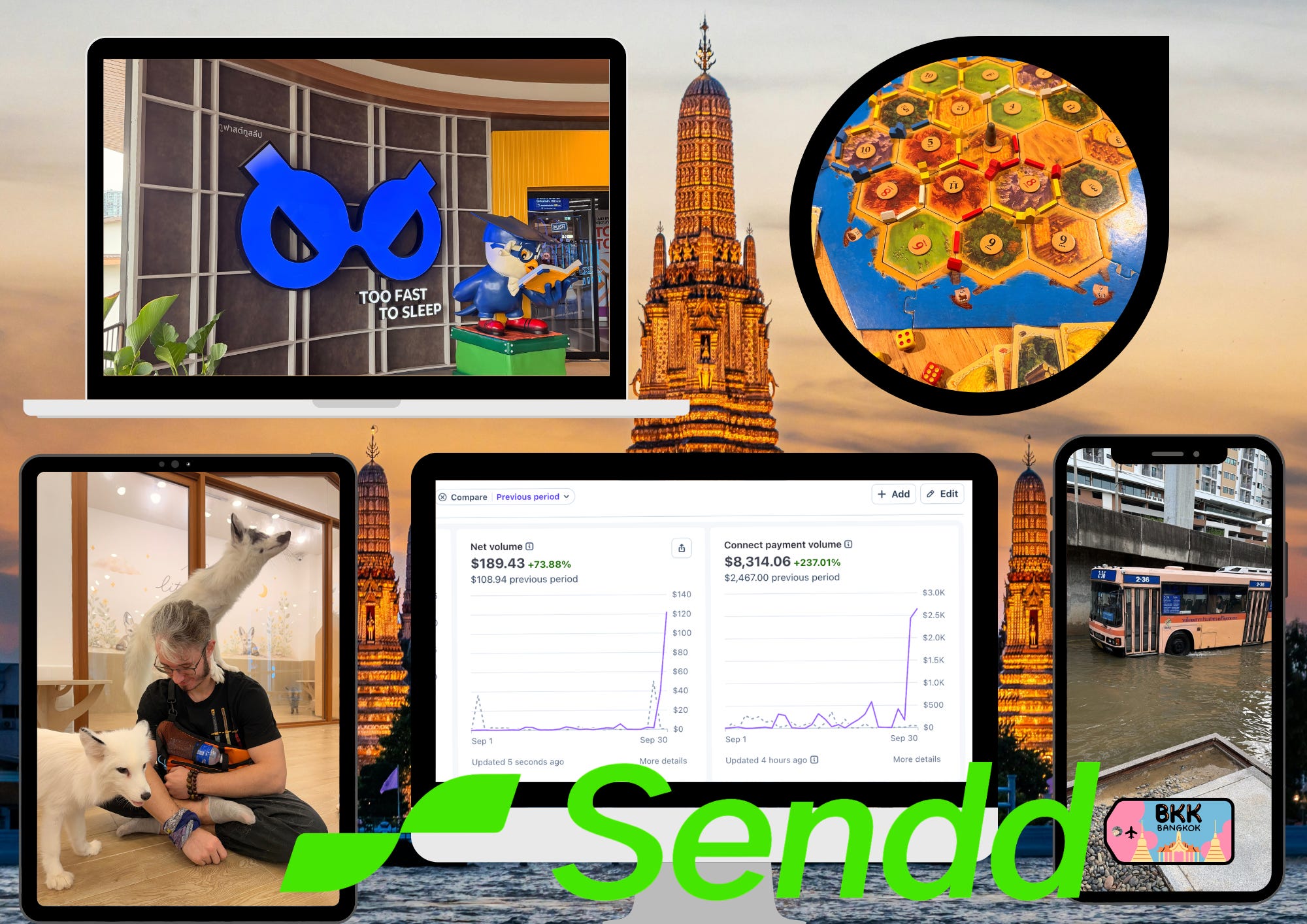
Traction (September)
274 stores (+19.13%, 44 new)
US$7,713.43 payment volume (NZ$13,597.05), +206.62% MoM
119 paid orders, +65.28% MoM (148 including free tickets and comps)
~US$77 Sendd revenue (our 1% of payment volume), up from US$24.37 in August
11 stores took paid orders this month, up from 9 in August
23 marketplaces, 36 marketplace sellers and 146 marketplace listings
Lifetime: US$21,363 payment volume (NZ$36,920), 654 paid orders and ~US$216 Sendd revenue
29.1K organic views: 25.3K on the Sendd.store accounts (13.2K Instagram, 12.1K TikTok), up 15.53% on August’s 21.9K, 3.8K on my personal accounts (3.1K Instagram, ~800 LinkedIn).
Summary
It feels like a short month since I last wrote, and also a lifetime ago, because of how much we’ve shipped in the last three weeks. This was month one in Bangkok with the full time engineering team in one room. We are Sendd-ing it. We’re spending September and October cooking on product, then moving to sales and marketing from November. The aim is to make the product 10x better in these two months. Month one: delivered.
In many ways, Sendd works like an AI company. We release a capability, benchmark what it does on day one, then keep iterating on that vertical so it gets better every cycle. Eventually every category will be best in class in our industry.
A funded startup chose Sendd for its first ever product launch. They picked us over Shopify and every other platform, and they found us because we share what we’re building publicly, on socials and in these updates. As a funded startup they came with a long checklist and plenty of questions about what Sendd could do. We worked with them closely over the last month on their launch, and it shaped the product more than anything else this month. It’s also why accommodation and services got pushed (see What Moved).
The startup soft launched to its email list on 29 September, as a test before its main launch on Monday 5 October. It did NZ$4K (~US$2.3K) in sales in the first hour and around NZ$9.5K (~US$5.4K) so far!!! If they sell out, that’s NZ$55K (~US$31.2K) in volume through Sendd, nearly one and a half times everything we’ve processed since launch. Monday is going to be a big day. We’re proud to be part of their journey as they grow. The team worked incredibly hard to deliver a product that’s simple but powerful, and I’m confident we can now start going head to head with Shopify in NZ and Australia on physical product sales.
One cool story from it is GoSweetSpot. GSS is integrated natively in Sendd for NZ and Australia, and the launch test runs surfaced a whole range of fixes and upgrades we needed to make. We made them, and NZ and Australian sellers will benefit for years. One issue we couldn’t solve on our own. Jarrod, our account manager at GSS, pulled one of their engineers into a call, and it turned out what Sendd is doing hasn’t been done at GSS before. We were escalated to a senior developer there and are now working with him on the next level of shipping for Sendd x GoSweetSpot customers. Soon our sellers will have the best rates, the best experience and no subscription, plus shipping capabilities they can’t build or buy anywhere else, native in Sendd. Shopify Plus starts at US$2,300 a month, and NZ sellers on Shopify Plus pay that for a fraction of the simplicity and capability Sendd delivers natively today.
We signed with ShipStation!!! A huge thank you to Chase at ShipStation, who worked with us super closely, advocated for us and got us a partnership agreement that’s going to be epic for Sendd and every customer we have now and in the future. We’re building the integration now, and it will be live for all customers in eligible regions soon.
ShipStation runs shipping, workflows and logistics for some of the largest brands in the world, and all of that will be native in Sendd. 99% of small businesses are either priced out of these capabilities or scared off by the cost and complexity of finding someone to set them up. And like everything we do, there’s no subscription. No tiers and no plans to compare: you get everything on day dot.
Sendd will charge a small usage fee to cover our costs where a shipping partner charges us for ongoing usage. We’ve set it at US$0.20 per label, and it’s free once you pass 500 labels a month. Imagine giving someone doing $200 a month in sales the same power as someone doing $2m a month. That’s already a reality in Sendd, with more markets coming soon.
PostHog is live. It’s made a big difference to how fast we learn, how fast we act on customer feedback and how quickly we can see where customers get stuck. Our platform data syncs into it every 12 hours, product events have been live since 14 September and the volume, order and store numbers above came straight from a dashboard built for this update.
An interesting thing I’m observing, recently Instinct raised US$1B at a US$10B valuation, four times what it was valued at a month earlier. It’s a personal AI agent that handles life admin by text and phone: trips, groceries, bookings, cancelling subscriptions and buying from businesses. I’ve enjoyed playing with it, and it’s a powerful product. The bet investors are making is that whoever owns a person’s attention owns how they get things done, including how they buy.
While that is true, I’m less sure that the attention layer stays solid or sticky for long. People move to whichever assistant is best right now, and the assistants already in people’s phones and inboxes (Gemini, Meta’s Muse, ChatGPT) are all competing for it. Whichever one wins, it still needs the other side: a business that can reliably take the order, the booking and the payment. My personal thesis lives more on this side.
This side is being built quickly, but mostly for big retail. Shopify and Google launched the Universal Commerce Protocol this year so agents can check out with merchants, and it’s live for millions of Shopify stores. Amazon, on the other hand, is blocking outside agents from shopping on its site, including Meta’s Muse, while Meta plans to take a small fee from merchants on transactions Muse completes. What’s missing is everyone else: the market stall, the tour operator, the school fundraiser, the motel. Most don’t have a catalogue, availability or a checkout an agent can use, so today an agent has to email or call them. That costs more, is less reliable and still leaves the business processing the order by hand.
That’s the work we’re doing. Product type by product type (tickets, stalls and experiences, with accommodation and services next), we’re giving small businesses a store that’s agent-ready from day one, with Rocky and the MCP built in, for a 1% fee and no subscription. We’ll plug Sendd into the open commerce protocols, so every Sendd store and marketplace can be found and bought from, safely, by whichever assistant a customer chooses. The same intelligence layer powers the MCP & Rocky could one day power a buyer-side assistant across every Sendd store and marketplace. For now, the rails come first.
It’s also why we built Sendd from the ground up instead of as a Shopify extension. Bookings, availability, marketplaces and per-store policies have to live in the core for an agent to use them. It will take time for this thesis to play out. I’m a strong believer that scale and product richness, combined with ease of use (now through intelligence), will ultimately win. But if you’re not the core infrastructure powering it, you’ll always be on unstable ground.
There are endless startups trying to eat Shopify’s lunch. At Sendd we think about this differently. We are starting to switch customers from Shopify to Sendd, and as the leader in the space, Shopify is a useful benchmark. But the hard reality is that there are 2–3 million actively trading Shopify stores and 330–400 million businesses in the world. I think that number will grow as AI destabilizes the economy and more people become business owners and sole traders instead of having regular jobs. For most of those 330 million+ businesses, and the hundreds of millions still to come, Shopify or a lookalike won’t be the answer. Sendd can be.
That’s why Sendd is so focused on going vertical by vertical, adding intelligence at every layer and building the infrastructure and capabilities from the ground up to deliver the outcomes we know we can. We’re making life simple for business owners, at a lower cost and with more power per punch, so they can kick ass with Sendd in their corner every step of the way.
Product Updates
What We Shipped
Experiences V1. Live. We’re rolling it out to our core group of customers first so we get early feedback to improve it.
Sendd Home. The first dashboard in Sendd for store owners. Live visitors, what needs attention (orders to fulfil, low stock and more), sales, orders, conversion rate, AOV, sessions, sales over time, funnel, top listings, sales by channel and recent orders, all comparable against the previous period.
Analytics. A new section with three tabs. Sales takes a store from gross to net, showing what it keeps after marketplace, payment and other fees, plus taxes, currencies and more. Traffic breaks down sources, devices and regions. Live shows what’s happening on the store right now, about a minute behind real time.
Rocky and the MCP can see and do more. New endpoints, for example: an event organiser collecting dietary requirements at checkout used to go order by order to work out the catering. Now they ask Rocky or the MCP and get the list.
Shipping. Courier cut-off times, delivery estimates, a clearer live rates display for buyers, ship-to countries, free shipping countries and reusable packages, so dimensions and weights are set once and used across products.
Free shipping coupons. Coupons can now give free shipping at checkout.
Stock reservation. Stock is held for a set time when someone adds it to their cart and released if they don’t check out, so stores with only a few units don’t double sell.
Business and taxes. Stores can add their business and tax details, apply them across all products or set them per product, show GST and taxes correctly at checkout and export tax collected reports for Xero.
Review timing. Stores choose when review request emails go out, so a cosmetics brand can wait until the customer has actually had time to use the product.
Legals. New Sendd Store terms and policies, the first update since launch in February, plus per store terms, refund and shipping policies so each store has its own. V1 is live and already in use, with more updates to come. (Refund/Shipping coming soon.)
Cookie consent for store tracking, switched on in the regions that require it.
Stripe Standard. Stores now connect Stripe as a Standard account instead of Express, which gives each store full control of its own Stripe account, including payment methods. Stores on the old Express setup can disconnect under Danger Zone in Settings and reconnect to switch.
What Moved
Accommodation, services and Sendd.market product types. Not started. We held them back to get the customer launch right.
The Good
September was our biggest month ever, passing April’s US$5,952.
The team is learning board games, meeting foxes and other animals in Bangkok.
We experienced the best of Thai people and their creativity and way of life in the floods. From the Grab drivers, wading through water to deliver the food. To the local comedy of people getting grab boats and everything in between.
We are loyal customers to 7/11, I think it might have the highest amount of repeat customers and retention of any business. We’ve been doing 3-4 trips a day. Maybe even more during the flooding.
Month one was epic, more to come in month two. I’ll share more on the cool things we did as a team in the October update!
The Bad
Bangkok got flooded and we were all stuck in our own apartments for 3 days. No big deal. All good things otherwise.
I think our referral program isn’t working, I think we have the wrong incentive structure in place. So I need to re-think this and how we do it better.
Previous Goals (September)
Product
Experiences live: Done ✅
Accommodation live: Not Done, see What Moved
Services live: Not Done, see What Moved
PostHog live for us as a platform: Done ✅
Team
Full time team in Bangkok from September: Done ✅
Sendd.market
All core product types live on marketplaces: Not Done, see What Moved
Content
A daily post-workday update on what we shipped: Semi done!
Goals to 4 November
These run until I’m back in NZ on 4 November.
ShipStation live
Accommodation live
Services live
AI Web Builder V1 live
MCP live with all endpoints, with matching APIs for us to start enabling developers on Sendd
Financials
September burn: ~8k NZD, down 27.27% from ~11k in August. October is the second and final planned month of Bangkok costs.
Runway: Bootstrapped. Burn comes back down after October.
🎯 The Ask
This month’s biggest win came from a brand finding us because we build in public. If you know a brand getting ready to launch a product in NZ, Australia or the US, I’d love an introduction.
📅 Grab 15 minutes with me: https://sendd.store/sendd
The Sendd Team,
Adi, Dev, Tum, Ben, Kenia, Vlad, Maria, Jackie, Roland, Aman & Gleb